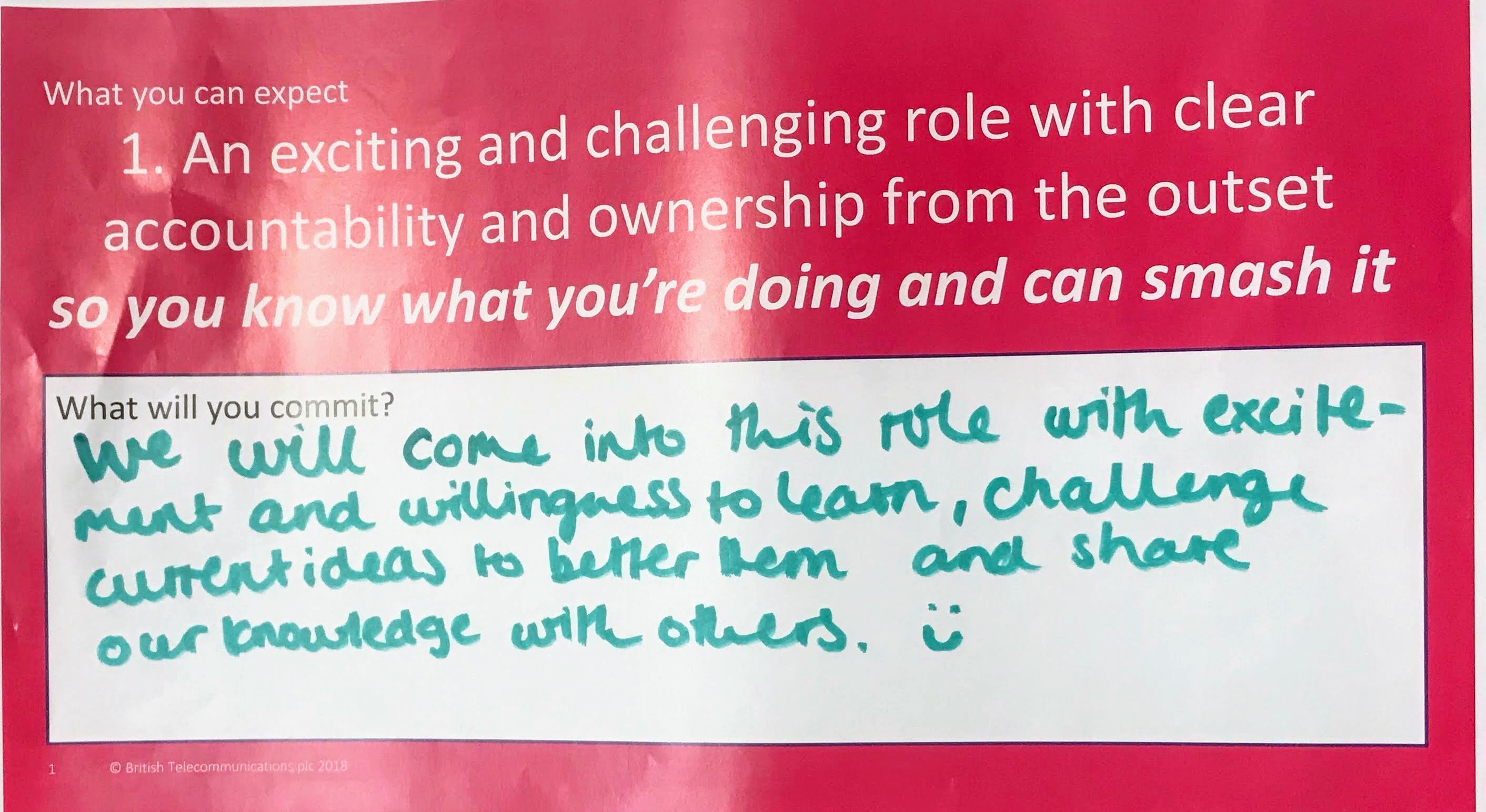
A commitment we made during our induction. It reads, “We will come into this role with excitement and willingness to learn, challenge current ideas to better them and share our knowledge with others.”
Work has become the centre of my life and where I spend most of my time (unsurprisingly of course, as this is what life after University is like!) but I feel like I haven’t had a minute to properly stop and reflect on my work life recently. So I wanted to take the time to write about the last 6 months since I started my graduate training programme with BT.
This is mostly for me to gather my thoughts and to document it, but I hope that my learnings will help fellow graduates kick starting their life after university too.
#✅ My first rotation is done… already!
Even writing “the last 6 months” is so weird. I still feel like it’s my first week going into work! Although I’ve worked in fast paced environments before such as in retail, it seems as though time flies faster in the ever changing tech world. There is always so much going on.
For those that are unfamiliar with a graduate programme, they are typically 2 years long structured in a way where you are able to go around different teams to get an insight of what being in each team is like.
When I was picking my first rotation, I wanted to get away from the coding aspect of tech for now and explore the other aspects I’ve never really had the chance to in past tech internships. With this in mind, I spent my first 6 months in the business sitting with the Digital Architecture team.
An overview of my 2 years ahead
#👷🏻♀️ Architecture?
I honestly didn’t know what to expect. I had heard of Architecture mainly from my dad, who is an Architect. But you know, the type of Architect that designs buildings and makes rooms feel balanced and look pretty. I had also heard of Architecture from the Twitter Tech space, but again, I didn’t really understand the role at all. Coming from a Biomedical Sciences background and literally being taught at school on the limited jobs out there, this was a totally new world.
I felt like I did throw myself in the deep end but that is what graduate schemes are for… to get out of your comfort zone and to learn.
And that’s exactly what I did. On top of learning about my role and responsibilities, I was also learning about the wider business – how everything worked from what others outside my team’s responsibilities are, how stuff is released to how to book annual leave on a very confusing (at first) HR system. Day in day out, learning so much to the point where I couldn’t do anything else after work but quickly eat something then sleep by 8pm.
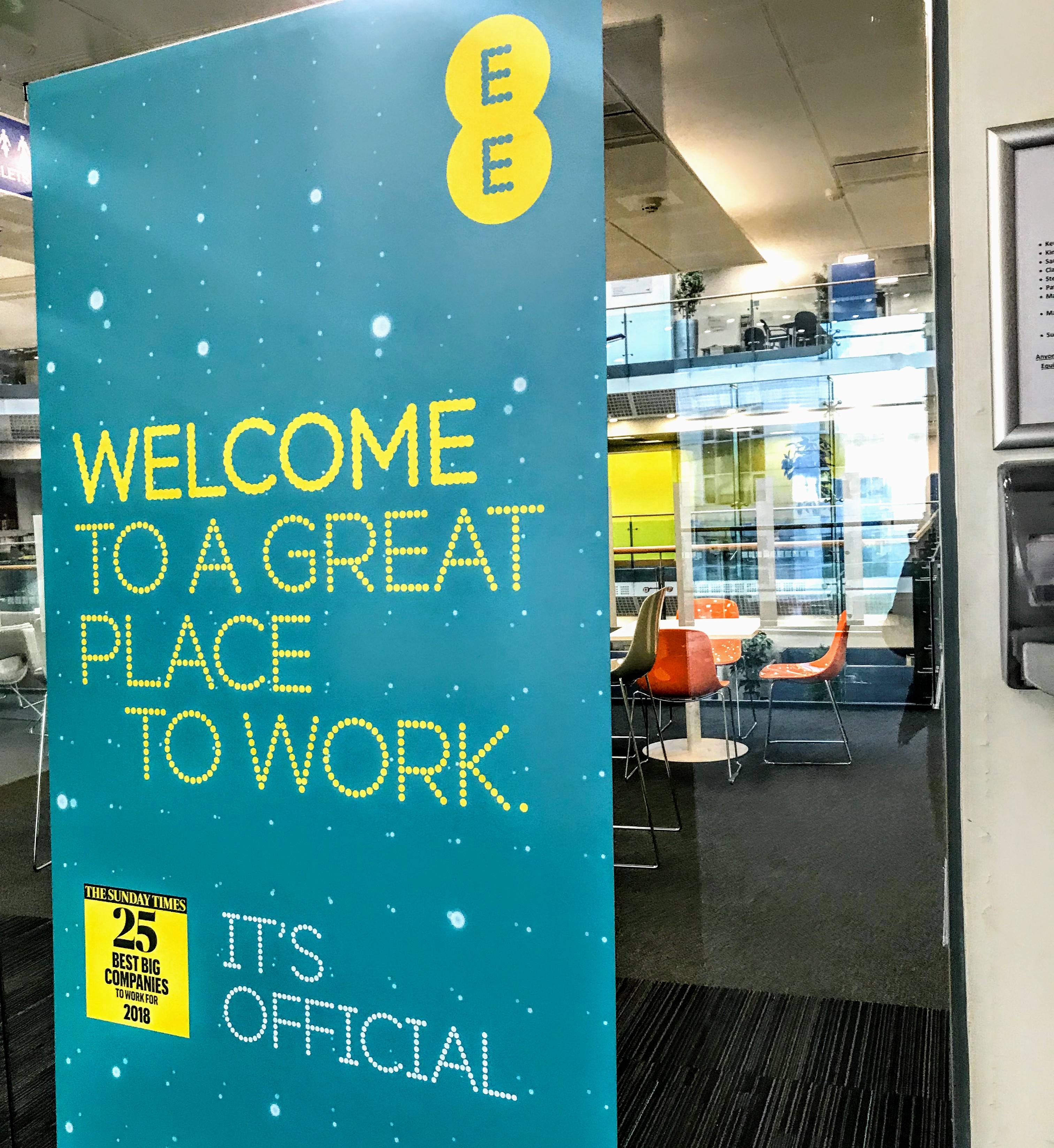
A EE banner that reads: “Welcome to a great place to work.”
This is a totally normal thing when you start a new job, but I was initially very overwhelmed by it all. I am proud to say that now I’ve adapted to the environment a lot better, I now feel better at handling my overwhelm and can now maximise my days (instead of literally getting home and sleeping 😂)
My day to day in the Architecture team gave me a fantastic insight of how the whole Digital teams work together in the project lifecycle. It helped me understand what “the business” needs are and the impact of the early engagement phases are on our end customers. Although actually developing features are an important part of a project (after all, it’s no use talking about ideas without actually building them), I started to appreciate the work that goes on before this and how it can really shape how the development teams approach things.
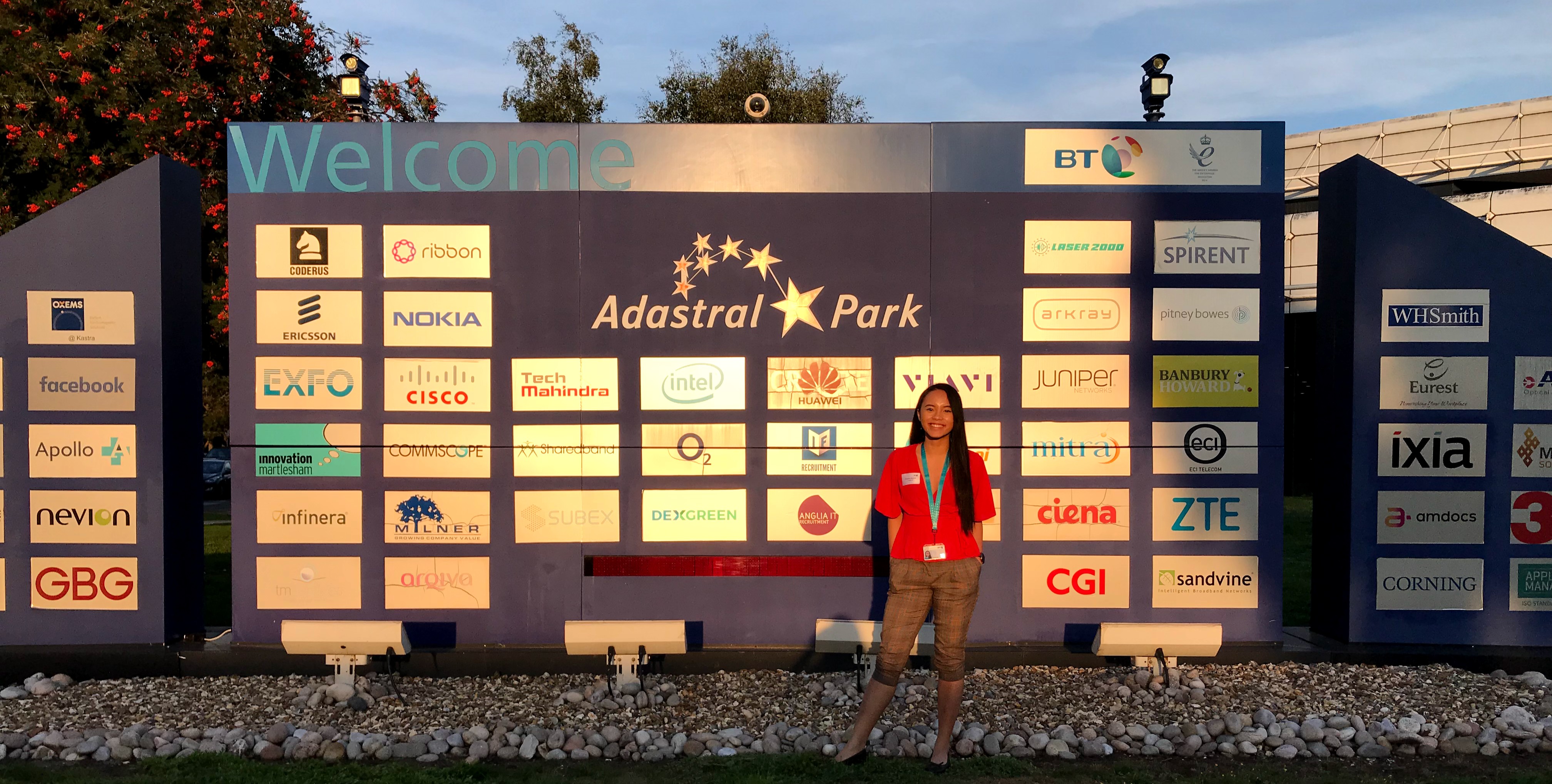
A photo of me at Adastral Park in Ipswich – BT’s research and innovation centre
In my rotation, I had the chance to engage with stakeholders to get a better understanding of project requirements, created documents (or artefacts) for Digital work, present everything I learned back to other teams and look into current tools and technology to improve ways of working.
The start of my graduate programme in Architecture allowed me to gain a high level view of what was going on in the Digital Engineering teams. I think most prominently, this rotation helped me gain confidence in presenting and speaking to stakeholders. By the end of it, I was proud of hitting my objectives, developing myself personally and making progress with my understanding.
#✨ Other contributions
This wouldn’t be me if I didn’t write this section. 😆
BT’ gives employees the opportunity to get involved with other things outside the day-to-day, whether that be voluntary work or spreading awareness at schools and universities… it has definitely been a fantastic for both self-development and creating a positive impact.
On #IWD2019, a big thank you to Pauline and all my colleagues across our three brilliant brands who are working to make gender equality a reality – something in which we must all play our part. https://t.co/YL51QZngq4
— Marc Allera (@MarcAllera) March 8, 2019
In my 6 months, I was able to get involved in a number of things:
- FurtHER programme – a Code First: Girls run course for women to learn how to code and pave the path for a job in technology. I was able to be a buddy for the course where I supported my mentee for 4 months on her journey in becoming a Software Engineer!
- Gender Diversity Network – I recently organised an International Women’s Day event with GEN as well as raised awareness of what the network do to fellow colleagues in the North.
- Gradventure – my team and I raised £1000+ for UNICEF – BT’s chosen charity of the year.
- Campus Champions – this is a scheme that encourages graduates to go to Universities and promote their experiences of the scheme so far to current students.
- Employee Advocacy Programme – this is a scheme that encourages “social ambassadors” to regularly share BT experiences online and beyond.
- Graduate Recruitment process – I helped out at two assessment centres for the next intake of the graduate programmes. It was strange being on the other side of the interview process, but I thoroughly enjoyed it!
I quickly learned that although other contributions are great, it isn’t as easy as when I was a student where contributions could easily fit around lectures and labs.
With that said though, these wider contributions in particular those that help others, is one of my reasons why. A purpose, if you like. So I don’t want to completely stop them (I literally won’t ever 🙈), but have had to have honest conversations with myself about capacity. Because sometimes, it’s just not feasible.
#🚀 What’s next?
I’m very excited for my next rotation where I’ll be sitting with the development teams. I’ve already had a week to settle in and so far, I’m really enjoying myself! It’s nice to go into more detail and be a bit more focused on one product rather than look at several different systems.
It’s my first official day in my Dev rotation and I’ve attended my second stand-up, drank too much coffee and have a shiny dev machine.
It’s all feeling very real now 🙈 pic.twitter.com/NPNScXN5GD
— Pauline P. Narvas (@paw_lean) March 4, 2019
I’ve set myself some fresh new objectives, ready to see where I’ll be in 6 months time. Bring it on!
My 6 months into the workforce has been such an experience! It has come with waves of learning and challenges, but I believe that all of these are the building blocks to become a better person.
🎉 Win 🎉
I finished Feb with a summary presentation about my graduate scheme at @EE so far before I move into my next team in dev (#devlife come @ me!)
These last 6 months have been challenging but everything has been invaluable for my learning ✨#consumergrads pic.twitter.com/Q1fV0GwzT0
— Pauline P. Narvas (@paw_lean) March 1, 2019
My key lesson from the last 6 months has to be that no one knows everything. I learned that asking questions will usually lead me to a tiny piece of information and that over time, these little puzzle pieces will come together. So it’s okay not to know everything – I shouldn’t put so much pressure on myself to know everything, because no one really does.